

At Chatterbox, authenticity isn’t something that hides behind glass or a kitchen door. It’s a living thing. You feel it in the steam that curls off a plate of chicken rice, in the quiet nod of someone who takes that first bite and says, “This tastes like home.”
For years, Chatterbox has done something rare. It’s taken Singapore’s most familiar dish and lifted it into the setting of a five-star hotel, not to make it fancy, but to show how tradition and elegance can sit at the same table.
Singapore has never been afraid of change. The streets modernise. New cafés appear, then disappear. The old coffee shop finds itself next to a sleek dessert bar. Somehow, everything blends.
And through it all, people keep asking the same question: What is authentic Singaporean food?
Everyone has their version. To one person, it’s the sting of chilli crab sauce eaten with bare hands. To another, it’s the burnt edges of satay fresh off the grill. There’s no single answer, and that’s the point.
Authenticity here is a moving target. It’s as fluid as the city itself. It lives in memories, not manuals.

We love to talk about “the original”—the first version, the pure one. But in truth, there’s no such thing.
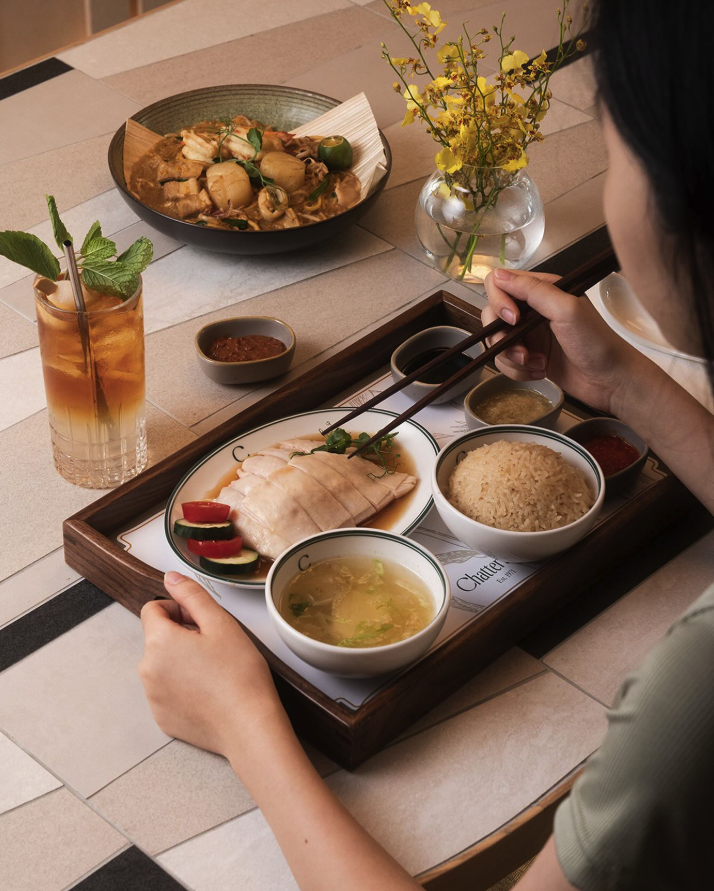
Take Hainanese chicken rice. Its bones are from Hainan, China, from the progenitor Wenchang chicken. But the version that Singapore calls its own, the one soaked in broth, slicked with chilli and ginger, was born from migration, adaptation, and survival. It changed because it had to.
That’s how most great dishes begin here. Out of necessity. Out of creativity. Out of love for taste itself.
Authenticity isn’t the opposite of change. It’s proof that something has lived long enough to evolve.

Food, for Singaporeans, has always been emotional. It’s never just about flavour. It’s about who you ate it with, and when.
You could be standing in a hawker centre at midnight, or sitting at a restaurant with linen napkins. Either way, that first spoonful carries history. Maybe it’s your mother’s cooking, or a memory of queuing at your favourite stall after school.
That’s why authenticity isn’t in the recipe. It’s in the moment it brings back. It’s what happens when taste meets memory.

Somewhere between the old kopitiam and the new fine-dining kitchens, Singapore found its balance. Younger chefs began to reimagine heritage dishes, not to outshine them, but to see what else they could say.
You might find laksa turned into a delicate bisque. Or pandan reintroduced as an elegant cream folded into a dessert.
Not everyone agrees with these interpretations, of course. Some insist the old ways are sacred. But change, in food, is inevitable. And when it’s done with respect, with love for where it came from, it becomes a continuation of the same story.
It’s the same spirit, just written in a new language.
Ask anyone to describe Singapore’s food identity, and they’ll pause. Then smile. Because it’s not one thing; it’s everything.
Malay, Indian, Chinese, Peranakan, Eurasian—centuries of influence have mingled in one tiny island, and the result is something you can’t find anywhere else.
Maybe that’s why food feels so personal here. It’s a kind of mirror that reflects who we are, where we’ve come from, and how we’ve learnt to live together.
Each dish carries a piece of someone’s story. A borrowed spice, a shared method, a local twist. And somehow, it all fits.
Tradition isn’t meant to be trapped in time. It’s meant to breathe.
You see it every morning in the old men who stir their coffee the same way they always have, newspaper by their side. You see it in the teenagers discovering kaya toast again, even wearing them on t-shirts, not because it’s retro but because it’s good.
Heritage in Singapore isn’t an exhibit. It’s alive. It’s felt in the hum of conversation over breakfast, the clang of a wok echoing through an open kitchen. It’s messy, noisy, and endlessly alive.

When Chatterbox opened in 1971, it changed the way people saw local food. Chicken rice, once something eaten at a street stall, was now being served with quiet ceremony in a hotel dining room.
Transcending the concept of making it “posh”, it was about giving a humble dish the respect it had always deserved. The same flavours, the same spirit, simply framed in a new light.
That’s what Chatterbox has continued to do. It holds on to the soul of Singapore’s cuisine while showing that refinement doesn’t mean losing touch. It means paying attention. It means cooking with reverence.
Try defining Singaporean authenticity, and you’ll get lost in the blur, but maybe that’s exactly where it lives.
Food here is an ongoing conversation, where every cook adds a sentence, and every diner adds a memory. The result is a living story of connection.
Authenticity isn’t about staying the same. It’s about remembering why a dish matters and letting it keep growing.
So whether you’re eating from a plastic plate at a hawker stall or a porcelain one at Chatterbox, the underlying feeling is the same. Each spoonful assures warmth, familiarity, and pride.
Because authenticity isn’t a rule, it’s a heartbeat. It’s what keeps the city, and its food, alive.
Experience it here.

Opening Hours
Monday to Friday
11.30am to 4.30pm (last order at 3.45pm)
Monday to Thursday
5.30pm to 10.30pm (last order at 9.45pm)
Saturday, Sunday and Public Holiday
11am to 4.30pm (last order at 3.45pm)
Friday, Saturday and Public Holidays
5.30pm to 11pm (last order at 10pm)
Contact Details
Hilton Singapore Orchard
333 Orchard Road, #05-03
Singapore 238867
T: +65 6831 6265
M: +65 8028 3984
E: chatterbox@ouerestaurants.com


Subscribe for latest updates
Receive exclusive news access and updates